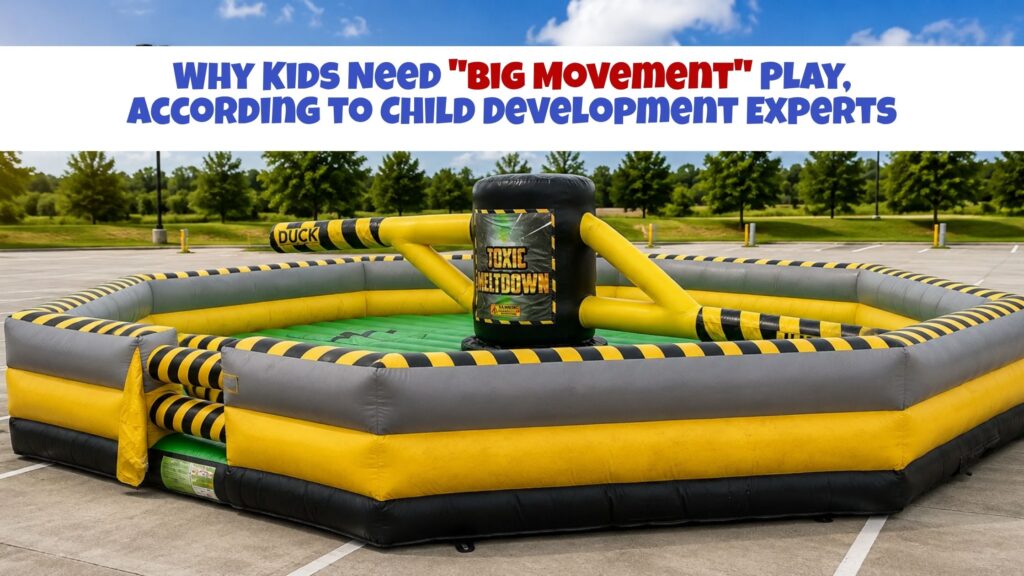
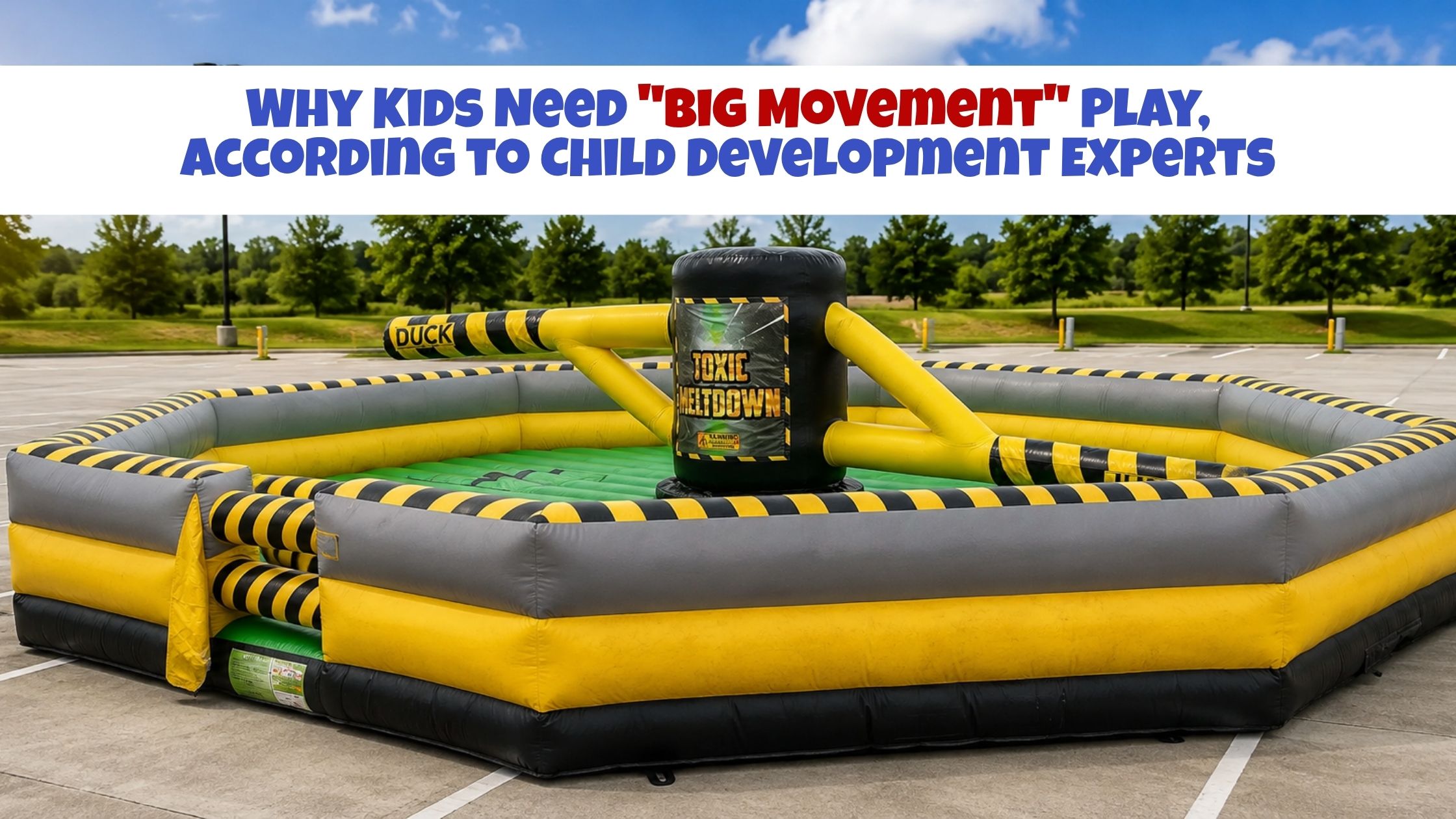
Kids need “big movement” play running, climbing, jumping, bouncing, crashing into foam pits because it’s how their brains build the wiring for focus, balance, emotional control, and confidence. Child development researchers call this gross motor play, and it isn’t optional extra credit. It’s the foundation classroom learning, sports, and even handwriting get built on top of. Skip it for too long, and kids don’t just get restless. Their nervous systems miss reps they can’t fully make up later.
The Kid Who Can’t Sit Still Isn’t the Problem
Here’s a scene every Houston parent knows. Your seven-year-old comes home from a full day of desks and worksheets, and within ten minutes he’s bouncing off the couch cushions like they’re a trampoline. Teachers sometimes read this as a focus issue. Occupational therapists read it differently: that kid’s body has been starved of big movement all day, and now it’s demanding the input it needs.
Gross motor skills the big, whole-body movements using the arms, legs, and torso aren’t just about physical fitness. They’re tied directly to the brain systems that control attention and self-regulation. When a child climbs, spins, or jumps, three parts of the brain fire together: the planning center, the movement-selection system, and the cerebellum, which smooths everything out so the motion doesn’t come out jerky. Every time a kid tackles a climbing-and-crawling inflatable course at a party the kind found in this obstacle-based party attraction lineup that circuit gets a workout most classrooms simply can’t give it.
What Counts as “Big Movement,” Exactly
Big movement play is anything that uses large muscle groups with real force and range not tiptoeing around a coloring station. Climbing a rock wall. Sprinting through a maze. Launching off a trampoline. Racing down a water slide and bellyflopping into the landing zone. These are different animals from fine motor tasks like coloring or stacking blocks, and kids need both. But American families have quietly cut way back on the big stuff. Recess keeps shrinking. Backyards get smaller. Screens fill the gap.
Occupational therapists with 15+ years in pediatric practice report something striking: gross motor skills predict academic readiness almost as reliably as early literacy does. A child who can’t yet control a jump, a climb, or a fall doesn’t have the postural stability to sit upright at a desk for six hours without wiggling out of the chair. Wiggling isn’t defiance. It’s a body asking for the kind of full-body bouncing you’d find in an inflatable jump-and-slide combo unit input it hasn’t gotten anywhere else that week.
Confidence Gets Built on a Bounce Pad, Not a Worksheet
I’ve watched this happen at dozens of backyard parties: a shy five-year-old stands at the edge of an inflatable, unsure. Ten minutes later she’s climbing, bouncing, laughing with three kids she just met. That’s not a coincidence. Physical risk-taking the safe, supervised kind teaches kids to size up a challenge and trust their own body to handle it.
Psychologists studying play call this “risky play,” and it’s linked to lower anxiety and stronger emotional resilience later on. A kid who’s fallen off a balance beam and gotten back up has practiced something worksheets can’t teach recovering from a setback in real time. Add a group of friends bouncing alongside her, and you’ve stacked social skill-building right on top of the physical win. This is part of why a spinning mechanical amusement ride booked for a fall festival does more than entertain it’s quietly building nerve.
The Brain Doesn’t Separate “Physical” From “Academic”
Here’s the part most parents miss. Gross motor development and executive function the mental skill set covering focus, working memory, and impulse control aren’t separate tracks. A study of children ages three to six found a strong, statistically significant link between large-muscle motor skills and executive function scores. Kids with better body control also showed better classroom self-regulation.
Movement releases endorphins. It also forces the brain to make split-second decisions about balance, timing, and spatial judgment, which is essentially strength training for the same neural pathways used in reading comprehension and math problem-solving. Districts that added short movement breaks between lessons reported better on-task behavior afterward not because kids burned off energy, but because their brains had just gotten a rep of coordinated, goal-directed motion. Families in Katy, TX inflatable delivery zones are catching on, scheduling active play specifically around exam weeks and long school breaks.
Why Foam, Water, and Spinning Rides Aren’t “Just Fun”
Different big-movement activities train different systems, and good child development programs mix them on purpose. Foam pits and soft-crash zones let kids take falls without fear, building the confidence to attempt harder physical challenges next time. Spinning attractions and swings develop the vestibular system the inner-ear balance mechanism most kids under-use if their week is mostly car seats and classroom chairs. Water play adds a sensory layer that calms overstimulated nervous systems while still demanding full-body coordination.
That’s the logic behind pairing a few different attraction types at one event instead of just one bounce house. A single afternoon that mixes a splash-and-slide attraction from this wet inflatable rental selection with a soft-crash foam session covers more developmental ground than either one alone. Kids don’t consciously register any of this, obviously. They just know it’s the best afternoon of their week and that’s exactly the point. Play that feels effortless is doing the most work.
Screens Aren’t the Villain – Sedentary Defaults Are
Nobody’s saying tablets are evil. The real issue is what movement gets displaced when screen time becomes the default filler activity instead of the occasional one. A child who spends two hours a day scrolling and zero hours climbing isn’t just missing exercise. He’s missing thousands of small proprioceptive signals the body’s sense of where it is in space that only come from real physical challenge.
Pediatric therapists suggest thinking of movement the way you think of sleep: a daily requirement, not a bonus. That doesn’t mean a formal workout. It means climbing, jumping, spinning, chasing, and crashing, ideally outdoors, ideally with other kids. Houston’s heat makes this harder for half the year, which is exactly why so many families lean on a bubble-and-suds crash zone booking to keep the movement going even in August.
Building More Big Movement Into an Ordinary Week
You don’t need a gymnastics membership to hit this need. A backyard obstacle course made from couch cushions counts. So does a driveway hopscotch grid, a game of tag, or twenty minutes scaling a harnessed vertical climbing attraction at a weekend party. The goal isn’t structured exercise it’s frequency. Little and often beats one big burst on a Saturday.
For bigger occasions birthdays, school field days, church festivals professionally set up attractions solve a real problem: safe, high-intensity movement in a controlled space, supervised by trained staff, with none of the setup work landing on the parent. Families served by our Sugar Land, TX event equipment delivery often build entire birthday themes around this idea now, mixing a bungee jump, a slide, and a climbing wall so kids rotate through several movement types in one afternoon instead of camping out on one attraction the whole time.
The Trade-Off Worth Making
Big movement play is loud, sweaty, and occasionally results in a scraped knee. That’s the trade-off, and it’s a good one. The alternative a childhood optimized for quiet and stillness trades short-term convenience for long-term deficits in coordination, confidence, and focus that show up years later in ways that are much harder to fix.
If you’re planning your next event and want to build real movement into it instead of just background entertainment, browsing the complete inflatable and mechanical ride inventory or getting in touch through our event planning request form is a good place to start scoping out what fits your space and age group. Kids don’t need more screen time. They need somewhere to run.
Frequently Asked Questions
At what age should kids start doing gross motor or “big movement” play?
Right from infancy. Tummy time is the earliest form of gross motor practice, and by toddlerhood, kids should be climbing, running, and jumping daily. The specific skills change with age, but the need for regular big movement doesn’t go away it just gets more complex, from crawling at one to skipping and climbing by six.
How much active play does a child need each day?
Most pediatric guidelines point to at least 60 minutes of moderate-to-vigorous movement daily for school-age kids, though it doesn’t need to happen all at once. Short bursts spread across the day recess, a backyard game, a bounce session after school add up and count just as much as one long workout.
Can too little gross motor play actually affect school performance?
Yes, and it’s more direct than most parents expect. Weak core strength and poor balance make it physically harder to sit upright at a desk for hours, and low gross motor skill scores have been linked to weaker executive function the same mental skills behind focus, memory, and self-control in class.
What’s the difference between gross motor and fine motor skills, and does one matter more?
Gross motor skills use large muscles for movements like running and climbing, while fine motor skills involve small, precise motions like writing or buttoning a shirt. Neither one matters “more” but gross motor development tends to come first developmentally and often lays the physical groundwork, like core strength and postural control, that fine motor tasks depend on.